
If you’ve spent any time interacting with Ethereum L1, EigenLayer, Symbiotic, or liquid restaking tokens (LRTs) like Ether.fi and Renzo, you already know the brutal reality: gas fees will quietly destroy your net yield.
It’s a classic trap for crypto hunters. You deposit $2,500 into a restaking pool expecting a modest 8% native APY plus point multipliers for a future TGE. But between the initial approval, staking interaction, LRT wrapping, and eventual claim/withdrawal steps, you burn $140 in gas. Before you’ve earned a single dollar of actual yield, you are starting at a -5.6% capital drag.
At DrpHunter, we track and execute multi-account farming across dozens of DeFi primitives. In this battle-tested guide, we’ll move beyond generic advice like “wait for weekends” and share our internal framework for minimizing gas drag while keeping your wallet positions active and high-scoring for airdrop criteria.
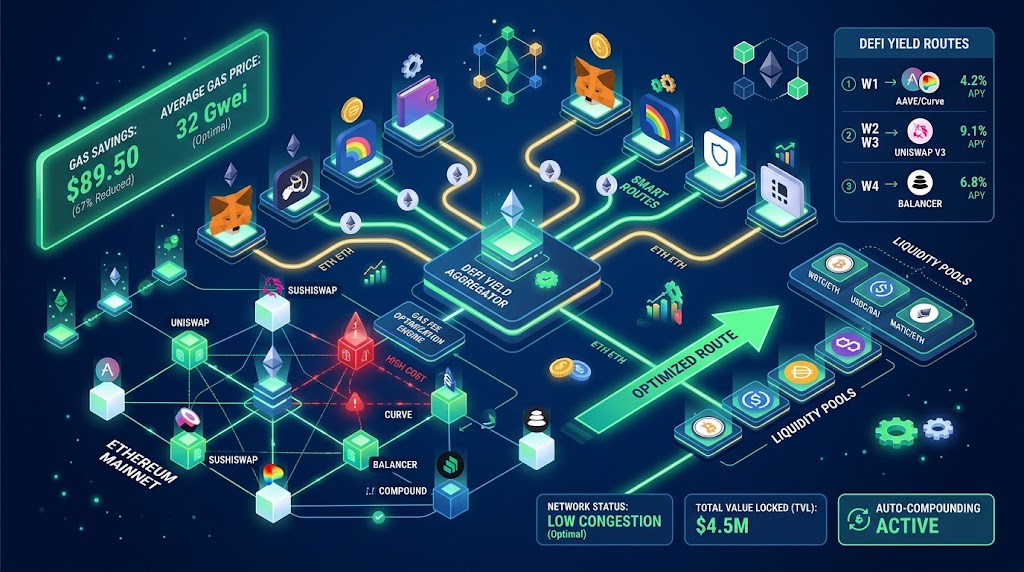
Key Takeaways & Golden Rules
- Target < 8% Gas Drag: Your total entry and exit gas costs should never exceed 8% of your total deposited principal over the expected holding duration.
- Batch Approval Signatures: Utilize Permit2 and ERC-2612 off-chain signatures to eliminate $15–$35 approval transactions completely.
- Bridge First, Stake Second: Leverage Native L2 Restaking integrations (e.g., Linea, Arbitrum, Base) to bypass Ethereum Mainnet execution costs entirely.
- Consolidate Interaction Batches: Schedule multi-protocol transactions using smart contract aggregators during predictable lower-activity time blocks.
1. Understanding the Math: The Real Cost of Multi-Protocol Farming
When you farm complex yield strategies—such as depositing ETH into an LRT, depositing that LRT into a restaking protocol, and then locking the receipt token into a DEX pool—you aren’t executing simple Transfer transactions (which consume 21,000 gas units). You are executing complex state updates that consume anywhere from 150,000 to 450,000 gas units per interaction.
| Transaction Type | Avg. Gas Units | Cost @ 12 Gwei ($3.2K ETH) | Cost @ 35 Gwei ($3.2K ETH) |
|---|---|---|---|
| ETH Native Transfer | 21,000 | $0.80 | $2.35 |
| ERC-20 Approval | 45,000 | $1.72 | $5.04 |
| LRT Minting (e.g. eETH/ezETH) | 160,000 | $6.14 | $17.92 |
| EigenLayer / Symbiotic Deposit | 230,000 | $8.83 | $25.76 |
| Complex DeFi Vault / LP Zap | 380,000 | $14.59 | $42.56 |
If you deposit into a 3-tier DeFi strategy during peak hours (35 Gwei), setting up your position can easily exceed **$90 in gas**. When you eventually exit, claim rewards, and convert back to base ETH, you pay another **$90**. That’s **$180 lost on round-trip friction**.
2. Battle-Tested Strategies to Cut Gas by 60–80%
Strategy A: The L2-First Restaking Loop
Many liquid restaking protocols now support direct minting on Layer 2 networks like Arbitrum, Base, Linea, and Blast via native cross-chain bridges. Instead of minting eETH or ezETH on Ethereum L1, bridge your raw ETH to Base or Linea for under $1.50 using canonical bridges or Intent-based bridges (like Across or Stargate), then deposit directly into the L2 vault instance.
Strategy B: Eliminate Token Approvals with Permit2
Standard ERC-20 `approve()` functions require an on-chain transaction that burns valuable gas. Modern protocols integrated with Uniswap’s Permit2 standard or EIP-2612 allow you to sign off-chain cryptographic messages for token approvals without spending a single Gwei.
- Always check if a protocol supports Permit Signature options before sending standard approval transactions.
- Use custom gas limits in Metamask or Rabby wallet when submitting transactions. Setting gas limit headroom to precisely match protocol requirements prevents unnecessary over-allocation during estimation.
Strategy C: Timing the Ethereum Blockspace Market
Ethereum mainnet gas price fluctuates on predictable diurnal cycles driven by institutional trading hours in North America and Western Europe.
🕒 Optimal Execution Windows (UTC)
Historical gas tracking shows that Ethereum Gwei consistently hits daily bottoms between 04:00 UTC and 08:00 UTC on weekends (Saturday & Sunday). Executing non-time-sensitive restaking deposits during these weekend windows typically reduces Gwei prices by 40% to 65% compared to midweek US market hours (14:00–19:00 UTC).
3. Account Abstraction & Smart Contract Wallets
If you are farming with multiple sub-wallets, manual execution across each account compounds human error and timing inefficiency. Leveraging Account Abstraction (ERC-4337) wallets like Safe (Gnosis Safe), Biconomy, or ZeroDev allows you to batch multiple multi-call operations into a single transaction wrapper.
Instead of executing 3 separate transactions per wallet (Approve -> Swap -> Restake), a smart contract wallet batches all three actions into one single execution payload, saving up to **35% total gas overhead** per wallet loop.
4. Verified Data & Benchmark Sources
To maintain accurate yield models, our team regularly pulls live telemetry from on-chain monitoring tools. Below are the primary benchmarks used in this guide:
| Metric / Tracking Tool | Data Category | Source / Reference Link | Use Case for Farmers |
|---|---|---|---|
| Etherscan Gas Tracker | Real-time Gwei & Heatmaps | etherscan.io/gastracker | Live base fee monitoring |
| L2Fees Tracker | Layer 2 Cost Comparison | l2fees.info | Choosing cheap bridging routes |
| Dune Analytics (@gas_price) | Historical Blockspace Metrics | dune.com | Timing low-activity hours |
| DefiLlama Yield & TVL | Protocol APY & Liquid Restaking | defillama.com | Evaluating net APY vs gas drag |
Summary Checklist Before Your Next Interaction
- Is current Ethereum Base Fee below 15 Gwei? If not, wait for off-peak windows.
- Can you use an L2 instance (Base/Arbitrum) instead of Mainnet L1?
- Does the protocol support off-chain Permit2 signatures to skip approval gas?
- Will your expected yield over 90 days significantly outweigh your round-trip gas costs?




Leave a Comment