
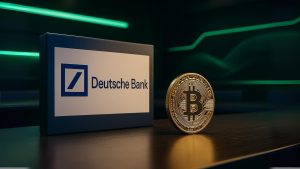
Deutsche Bank has officially entered the operational crypto custody market. Its November 11, 2026 launch gives eligible European institutional and corporate clients access to Bitcoin, Ether and three stablecoins through a regulated banking infrastructure. But for airdrop hunters, the more important development is what comes next: tokenized financial products, stablecoin infrastructure and the growing relationship between traditional banks and on-chain finance.
The Block source ·
Deutsche Bank official announcement
1. What Actually Happened on November 11?
Deutsche Bank’s crypto strategy has been developing for several years, but the November 2026 announcement represents a significant transition from planning to commercial operation.
In September 2026, the bank announced that it intended to provide regulated digital asset custody to institutional and corporate customers in Europe. At the time, the launch remained subject to regulatory procedures.
By November 11, the bank had announced that its Digital Asset Custody service was live for paying clients, following regulatory approval from Germany’s Federal Financial Supervisory Authority (BaFin).
The distinction is important. This is not simply another bank announcing an interest in blockchain technology. Deutsche Bank is now offering an operational service through which eligible customers can hold and transfer supported digital assets while the bank manages the associated wallets and private keys.
The five assets supported at launch
| Asset | Category | Strategic significance |
|---|---|---|
| Bitcoin (BTC) | Cryptocurrency | Institutional exposure to the largest crypto asset. |
| Ether (ETH) | Cryptocurrency | Exposure to Ethereum and its programmable financial ecosystem. |
| USDC | USD stablecoin | Dollar-denominated digital settlement and liquidity. |
| EURC | Euro stablecoin | Euro-denominated digital payments and settlement. |
| EURAU | Euro stablecoin | Access to AllUnity’s euro-denominated stablecoin infrastructure. |
Deutsche Bank: Original custody announcement
Notice what is missing: Solana, XRP and most smaller altcoins are not part of the initial offering.
This is a deliberately limited asset selection. Bitcoin and Ethereum provide exposure to established crypto markets, while the three stablecoins provide access to dollar- and euro-denominated digital money.
For institutional customers, the priority is not necessarily to support every token. It is to provide a controlled environment for assets that fit the bank’s regulatory, operational and commercial requirements.
2. How Deutsche Bank’s Custody Model Works
The central component of institutional crypto custody is private key management.
In a self-custody wallet, the user controls the private keys or recovery credentials needed to authorize transactions. Losing access to those credentials can result in permanent loss of funds.
Deutsche Bank’s model is different. The bank manages clients’ digital wallets and private keys on their behalf. Customers can hold supported assets and transfer them to third parties without having to operate their own custody infrastructure.
Security architecture
Deutsche Bank has described several security controls in its custody framework:
- Hardware-based key protection: Private keys are generated and protected using dedicated hardware.
- Segregation of duties: Different responsibilities are assigned to separate personnel.
- Multi-person approvals: Important transactions require approval from more than one authorized individual.
- Warm and cold storage: Separate storage environments help manage the balance between operational accessibility and security.
- Backup and recovery: Redundant technical infrastructure and controlled recovery arrangements support business continuity.
Official technical and security disclosures
However, institutional custody should not be confused with deposit protection.
Deutsche Bank explicitly warns that crypto assets are not protected by a deposit-guarantee scheme comparable to the protection available for eligible bank deposits. Custody reduces certain key-management risks, but it does not eliminate market volatility, fraud, cyber incidents or failures involving other market participants.
3. The Bigger Development: Deutsche Bank’s Stablecoin and Tokenization Strategy
The custody launch is only the first layer of Deutsche Bank’s broader digital asset strategy.
On November 11, Deutsche Bank also announced a memorandum of understanding with Deutsche Asset Management, its majority-owned asset management business formerly known as DWS.
The two organizations will explore cooperation in three areas:
1. Tokenized Money Market Funds
Traditional money market fund interests could be represented and distributed through blockchain-based infrastructure.
For DeFi researchers, this is important because tokenized fund products could create new connections between conventional cash-management products and blockchain-based settlement systems.
2. Crypto-Asset Exchange-Traded Commodities
The cooperation will also examine custody and settlement arrangements connected with crypto ETC products.
This could strengthen the infrastructure supporting regulated investment products linked to digital assets, although it does not mean that Deutsche Bank has launched a new crypto ETC product through this agreement.
3. Stablecoins and Liquidity Management
The agreement includes exploring stablecoin-related opportunities involving custody, settlement, liquidity management, treasury operations and distribution.
This is particularly relevant to airdrop hunters because stablecoin infrastructure is closely connected to DeFi lending, decentralized exchanges, payment applications and tokenized assets.
The Block: Asset management cooperation
Why the tokenized asset market deserves attention
Deutsche Bank Research reported that the global tokenized assets market, excluding stablecoins, expanded from approximately $10 billion in January 2025 to $39 billion in September 2026.
That represents an increase of approximately 290% over the reported period.
Deutsche Bank: Tokenized asset market data
The strategic takeaway is straightforward: institutional adoption is increasingly about financial infrastructure rather than simply buying Bitcoin.
Custody, stablecoin settlement, tokenized funds and liquidity management are interconnected components of a larger financial system.
4. What Does This Mean for Crypto Airdrop Hunters?
Deutsche Bank has not announced an airdrop campaign, points program or token reward for customers using its custody service.
There is also no confirmed evidence that simply holding BTC, ETH or stablecoins through Deutsche Bank will qualify a customer for any future blockchain airdrop.
Nevertheless, the development provides several useful signals for people researching early-stage Web3 opportunities.
Strategy 1: Follow Infrastructure, Not Just Token Announcements
Many airdrop hunters concentrate on projects that have already announced points, quests or token incentives.
A more forward-looking approach is to monitor the infrastructure being built before incentive campaigns become public.
For example, institutional interest in stablecoin settlement creates potential opportunities around:
- Stablecoin payment infrastructure.
- Cross-chain stablecoin transfers.
- On-chain liquidity and lending markets.
- Tokenized real-world assets.
- Institutional blockchain settlement applications.
These categories are not guaranteed airdrop opportunities. They are research directions that can help identify projects building around genuine financial demand.
Strategy 2: Distinguish Bank Custody from On-Chain Participation
This is probably the most important practical lesson for airdrop farmers.
| Activity | Potential On-Chain Signal | Airdrop Implication |
|---|---|---|
| Holding BTC in bank custody | Not necessarily visible as an individual user wallet | No automatic airdrop eligibility |
| Holding ETH in bank custody | Depends on custody structure and address attribution | No automatic DeFi interaction history |
| Holding USDC in custody | May not represent direct wallet activity by the customer | Does not automatically qualify for protocol campaigns |
| Using a self-custody wallet to interact with DeFi | Can generate attributable blockchain transactions | May satisfy specific campaign requirements |
| Providing liquidity to an eligible protocol | Can generate deposit, withdrawal and position records | May qualify if the campaign recognizes that activity |
A bank’s custody infrastructure and a self-custody wallet serve different purposes.
When a protocol evaluates airdrop eligibility, it may examine wallet addresses, transaction history, protocol usage, asset balances, holding periods and snapshot dates.
If a bank controls the private keys, the customer’s beneficial ownership of an asset does not automatically translate into direct control of the on-chain address used for protocol interactions.
Strategy 3: Research Stablecoin Ecosystems Before Incentives Become Crowded
USDC, EURC and EURAU represent different parts of the stablecoin market.
USDC provides dollar-denominated exposure, while EURC and EURAU provide euro-denominated alternatives. Their presence in an institutional custody offering highlights the importance of both dollar and euro settlement infrastructure.
For airdrop research, the useful question is not whether holding these assets earns rewards. It is which independent applications are building useful services around them.
Consider investigating:
- Protocols integrating multiple stablecoin types.
- Decentralized exchanges supporting stablecoin trading pairs.
- Lending markets with transparent liquidity and utilization data.
- Cross-chain settlement infrastructure.
- Tokenized treasury and money market applications with verifiable product documentation.
Before participating, check whether the protocol has an announced incentive program, whether its contracts have been audited, and whether the capital requirements make economic sense.
Strategy 4: Watch the Asian Expansion Timeline
Deutsche Bank’s institutional crypto strategy is not intended to remain limited to Europe.
In October 2026, Reuters reported that the bank planned to expand its digital asset custody operations into major Asian financial centers in 2027.
The bank’s broader strategy includes custody for major cryptocurrencies, stablecoin-related services and blockchain-based financial products.
For airdrop researchers, this creates several areas worth monitoring:
- Which Asian financial centers receive the first expansion?
- Will additional stablecoins receive institutional support?
- Will tokenized fund products become available to more regional clients?
- Will new partnerships emerge between traditional financial institutions and blockchain infrastructure providers?
Reuters: Deutsche Bank’s Asian expansion plans
5. A Practical Research Framework for Airdrop Hunters
Rather than immediately moving funds into new protocols, use Deutsche Bank’s announcement as a starting point for a structured research process.
| Research Stage | What to Investigate | Useful Evidence |
|---|---|---|
| Institutional Signal | Which banks and asset managers are entering digital assets? | Official announcements and partnerships. |
| Infrastructure | Which protocols support stablecoin settlement and tokenization? | Documentation and live integrations. |
| Funding | Does the project have credible investors or institutional partners? | Verified funding announcements. |
| Usage | Are people actually using the product? | TVL, transactions and recurring users. |
| Incentives | Is there an announced points or reward program? | Official campaign rules. |
| Risk | What can go wrong with deposits or transactions? | Audits, contract risks and withdrawal conditions. |
Capital allocation: Avoid farming every new narrative
Institutional adoption does not mean every project connected to stablecoins or tokenization will eventually issue a token.
For capital-efficient farming, separate research activities from actual deposits.
- Research first: Read official documentation, identify real product usage and verify whether rewards are announced.
- Test small: If an interaction is necessary, start with a limited amount that you can afford to lose.
- Track opportunity cost: Compare potential rewards against gas, bridge fees, withdrawal restrictions and capital lockup.
- Keep wallets separate: Use a dedicated farming wallet rather than exposing your main holdings to experimental applications.
- Record eligibility: Track transaction dates, campaign rules and wallet addresses.
For more advanced farming and portfolio management, read our Soneium Ecosystem Airdrop Strategy, which examines ecosystem participation and wallet activity.
6. Risks That Should Not Be Ignored
Deutsche Bank’s entry into crypto custody is a positive infrastructure development, but it should not be interpreted as proof that every part of the digital asset market is becoming safer.
Regulatory risk
Institutional custody depends on regulatory permissions, product approvals and ongoing compliance requirements. The assets and services supported by a bank can change as regulations and internal risk policies evolve.
Custody and counterparty risk
Using a regulated bank does not eliminate operational risk. Customers still need to understand account terms, withdrawal procedures, asset segregation arrangements and the legal treatment of their holdings.
Stablecoin risk
Stablecoins are not risk-free cash equivalents. Reserve management, redemption arrangements, issuer operations, regulatory requirements and market liquidity can all affect their reliability.
Airdrop speculation risk
Projects associated with institutional partners may attract speculative attention. However, a partnership, tokenization announcement or custody integration does not establish that an airdrop will happen.
For another example of how token supply and liquidity can affect airdrop-related decisions, see our Starknet STRK Unlock: 127 Million Tokens and Supply Impact.
7. What to Watch Next in 2027
Deutsche Bank’s custody launch provides several concrete developments that researchers can monitor over the coming months.
| Development | What to Monitor | Why It Matters |
|---|---|---|
| Asian Expansion | New regional launches and regulatory approvals. | Potential growth in institutional crypto infrastructure. |
| Stablecoin Integration | New supported assets and settlement services. | Expansion of digital payment and liquidity infrastructure. |
| Tokenized Funds | Actual product launches and distribution details. | More connections between traditional funds and blockchain networks. |
| Crypto ETC Cooperation | Custody and settlement arrangements. | Institutional access to regulated digital asset products. |
| New Protocol Partnerships | Documented integrations and live products. | Potential ecosystem opportunities worth researching. |
The key is to distinguish announcements from operational milestones. A memorandum of understanding is an indication of cooperation, not proof that a financial product is already available.
Final Verdict: Is Deutsche Bank’s Crypto Custody Launch Important for Airdrop Strategy?
DrpHunter Research View: A meaningful institutional adoption signal, but not a direct airdrop opportunity.
Deutsche Bank’s November 2026 launch is important because it connects regulated banking infrastructure with Bitcoin, Ethereum and stablecoin custody. Its cooperation with Deutsche Asset Management also expands the conversation toward tokenized funds, crypto investment products and digital settlement.
For airdrop hunters, the most useful opportunity is in following the infrastructure being built around these developments, not assuming that bank customers will receive free tokens.
Our recommended approach is to monitor stablecoin infrastructure, tokenized asset applications, institutional partnerships and genuine on-chain product adoption. Prioritize projects with working products and transparent participation rules over speculative campaigns built around institutional headlines.
In 2027, the most interesting airdrop opportunities may emerge from the applications connecting traditional finance with blockchain infrastructure. But identifying those opportunities early requires evidence, careful capital allocation and a clear understanding of how eligibility actually works.
Disclaimer: This article is for informational and educational purposes only and does not constitute financial, investment, legal or tax advice. Deutsche Bank’s custody service is designed for eligible institutional and corporate clients, not general retail airdrop participants. Crypto assets, stablecoins and DeFi protocols involve risks, including market volatility, counterparty failure, smart contract vulnerabilities and regulatory changes. Always verify information through official sources before transferring assets or interacting with a protocol.


Leave a Comment